By the measures that dominate conferences on Central Asia, the region is having a good decade. Its economies are among the better-performing in the world. Relations among its states are more open and constructive than at any time since independence. A region long described as the middle of nowhere, a landlocked dead end, is now discussed as a crossroads, with new routes running through it in several directions.
None of this should be taken for granted. Much of what we see today followed from two changes the region does not fully control. One was a change of political leadership at the top. The other was a change in the external environment that suddenly made Central Asia’s location useful to others. Both have been good for the region, and neither is guaranteed to last.
Opportunity and vulnerability arrive together
Kyrgyzstan is a good illustration, because it has lived on its location for almost three decades. After joining the World Trade Organization in 1998, the first post-Soviet state to do so, Kyrgyzstan became a re-export hub. Chinese goods came through bazaars such as Dordoi in Bishkek and Kara-Suu in the south, then moved on to Kazakhstan, Russia and further. With no oil or gas, and with gold mining still in its early years, this trade was for a long time the country’s main instrument of economic survival. At one point Kyrgyzstan was even re-exporting Russian fuel southward.
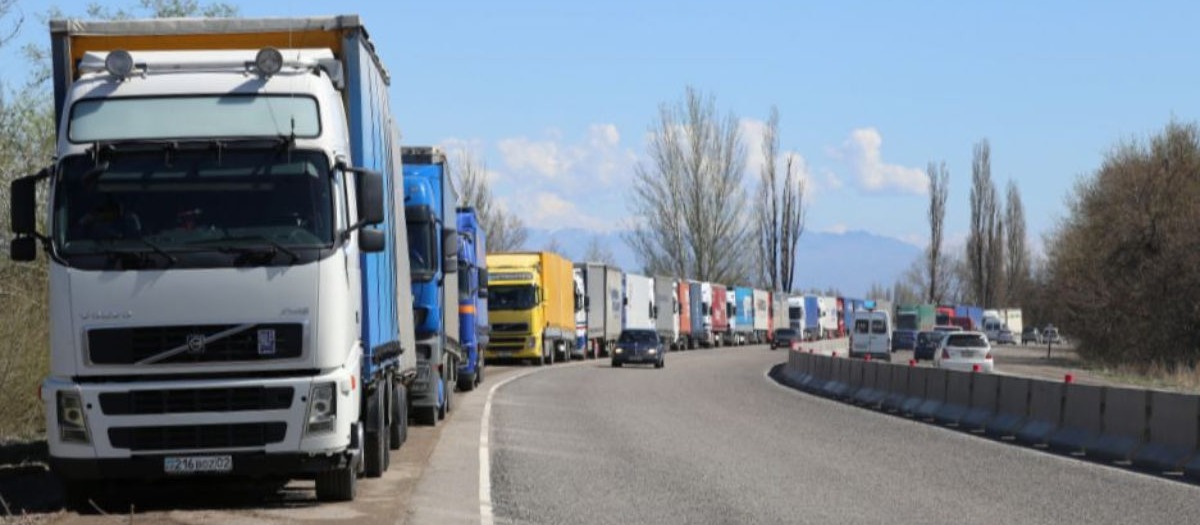
The direction of this trade is worth noticing. Connectivity in Central Asia is usually drawn east to west, along the Middle Corridor, or north to south. Kyrgyzstan’s transit ran east to north. After 2022 it also ran west to north, as Chinese and Western goods made their way to Russia through Kyrgyz territory. For a small landlocked economy this was a remarkable opportunity, and trade figures rose accordingly.
Then came the other side. Kyrgyz-registered companies began appearing on US sanctions lists in 2023. Keremet Bank was sanctioned by the United States in January 2025 and Capital Bank by the United Kingdom that August, and in May 2026 the EU banned transactions with both. The country faced questions about trade it had little capacity to monitor. The opportunity and the vulnerability turned out to be the same thing: a position in the middle of other people’s trade.
Being a corridor and controlling it are two different things. A country in the middle of any route, whether its ends lie east and north or west and south, depends on decisions taken at both ends. It gains a great deal while those decisions favour it, and it can lose a great deal when they change.
A boom measured against a low starting point
We speak of a boom in Central Asian connectivity today largely because there was no such boom a few years ago. For most of the time since independence, the region was remarkable for how little its states cooperated and how poorly they were connected to each other. Some borders were closed for years, and stretches of them were mined. In 2017, after a public dispute between the two presidents, Kazakhstan tightened controls on its border with Kyrgyzstan and trucks waited in queues for weeks. The starting point was very low, and that makes today’s progress look all the larger.
It also tells us where the progress came from. The obstacles to regional cooperation were mostly political, and so was the breakthrough. The change of leadership in Uzbekistan in 2016 opened borders, restarted dialogue and made it possible to settle disputes that had looked permanent. The road was not straight. Kyrgyzstan and Tajikistan fought along their border in 2021 and again in 2022, years into the region’s opening, before signing a border treaty in March 2025.
Today’s open relations are a real achievement. They are also owned, to a large extent, by a handful of people at the very top. Leaders meet regularly and agree on a great deal, while carefully avoiding the issues that might bring disagreement.
The external side of the story looks similar. The war in Ukraine and the breakdown of Russia’s relations with the West have raised demand for Central Asia as a transit route and reshaped the region’s agenda with the EU and China. This demand did not exist on today’s scale before 2022, and it may not survive a different settlement between Moscow and the West.
Looking toward 2030 and beyond, then, political leadership remains the critical variable, and it does not always work in one direction. What one leader opens, another can close. If the region’s connectivity was blocked by politics in the past, nothing guarantees that politics will not block it again.
Making the gains hold
The good times are the moment to make these gains less dependent on the circumstances that produced them.
Trusted relations with external partners matter, but the first task lies inside the region. Central Asian governments should remember why the region was not connected before, and make sure politics cannot easily disconnect it again. In practice, that means a shared commitment that freight crossings stay open during political disputes, with simple rules for notification and complaint. A bad day between two capitals should not mean trucks stuck at the border.
It also means shared digital transit and customs data and common statistics, so that traders can rely on predictable routes and governments can account for what passes through their territory. The gap is large. For 2023, Chinese customs recorded $19.7 billion of exports to Kyrgyzstan, while Kyrgyz statistics recorded $5.4 billion of imports from China. A state that cannot show what transits through it leaves others to decide for it.
Regional cooperation also needs permanent machinery: a small secretariat and working-level bodies that keep things moving between summits. Uzbekistan’s president proposed a rotating secretariat in November 2025, as part of turning the consultative meetings of heads of state into a “Central Asia Community”. It met little enthusiasm in the other capitals and has not been heard of since. So far the format has found it easier to grow wider than deeper. Cooperation should not have to wait for the next meeting of presidents to make progress.
Finally, cooperation needs layers below the state and independent of it. Business associations, media, universities and research centres working across borders are what keep links alive when relations at the top cool. In several Central Asian countries this layer is still thin, and in some it is under pressure.
The past decade has given Central Asia more openness and more trade than the two before it. The task now is to make that progress outlast the leaders and the circumstances that made it possible.
This commentary draws on the author’s remarks at the Think Road Forum 2026, hosted by the Institute for Advanced International Studies at the University of World Economy and Diplomacy in Tashkent on 4 and 5 November. The views expressed are those of the author.
Photo: Press Service of the Ministry of Agriculture of Kyrgyzstan.