
Shairbek Dzhuraev is President of Crossroads Central Asia
Originally published in German as “Depolitisierte Politik: Die Parlamentswahlen 2025 in Kirgisistan,” Zentralasienanalysen, No. 171, 20 February 2026. The English version reproduced with permission.
Download PDF
Kyrgyzstan’s snap parliamentary elections of November 2025 passed with remarkably little public drama. There was no nervous anticipation or widespread political tension. In a country where parliamentary elections twice led to regime overthrow, this contest unfolded as a largely procedural event. For that very reason, it is analytically significant. Rather than marking a step toward regime consolidation, the elections served as a clear demonstration of how consolidated the current political system already is.
Three broader takeaways stand out. First, the 2025 vote confirmed one of the few enduring features of Kyrgyz politics: electoral rules change at every parliamentary cycle. This time, party-list proportional representation was abandoned in favor of a single non-transferable vote (SNTV) system in multi-member districts. Second, the elections effectively closed Kyrgyzstan’s long-running experiment with party-based parliamentary politics. While party competition once promised institutionalized politics, it rarely produced parties resembling those found in model parliamentary systems. For much of society, the abandonment of party-list elections registered as little more than a footnote. Finally, the political context of the elections underscored Kyrgyzstan’s alignment with a broader regional, and arguably global, trend toward the strengthening of the executive at the expense of checks and balances.
New parliament by new rules
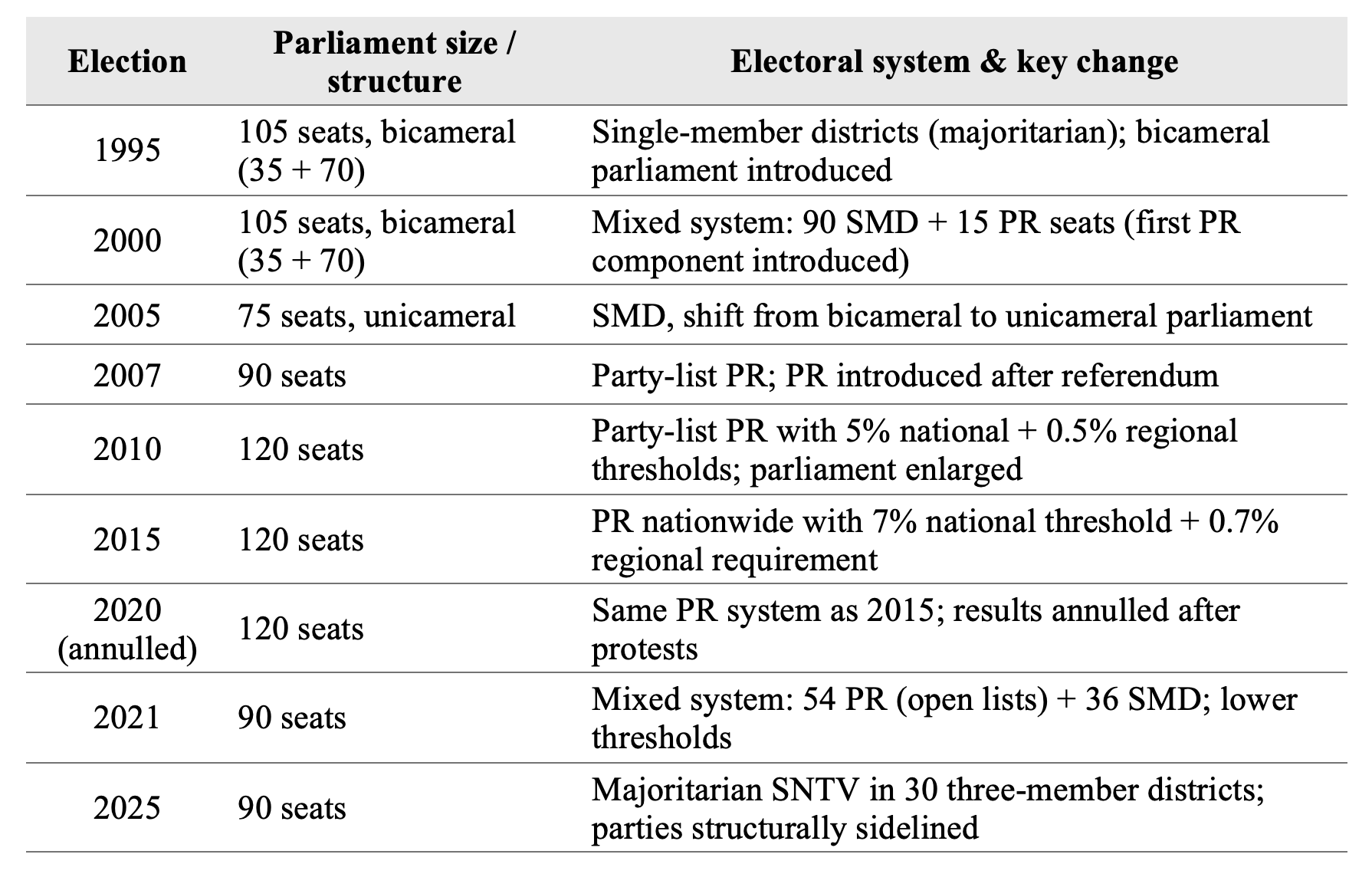
The 2025 elections confirmed a defining feature of Kyrgyzstan’s political trajectory: parliamentary elections are rarely held under unchanged rules. Since independence, Kyrgyzstan has never conducted two consecutive parliamentary elections using the same rules governing either the parliament’s structure or the electoral system (see Table 1). The only exception – the 2020 elections – ended with the annulment of the voting results.
The November 2025 elections represented yet another major redesign: a full transition to a majoritarian electoral model based on multi-member districts. In one sense, this marked a return to familiar territory – district-based majoritarian elections were used in 1995, 2000, and 2005. At the same time, the reform introduced an important novelty: the adoption of the SNTV system, under which each of 30 constituencies elected three parliament members.
Table 1. Changes in Kyrgyzstan’s Parliamentary Electoral System, 1995–2025
Under the new system, voters cast ballots exclusively for individual candidates, not for parties. Political parties were formally permitted to nominate candidates, but in practice only one party, Yntymak, did so. This outcome was not mechanically predetermined by the electoral formula. In other contexts, parties can and do dominate even under candidate-centered electoral rules. The marginal role of parties in the 2025 elections therefore reflects not only the design of the system, but also the broader irrelevance of parties as meaningful political institutions in Kyrgyzstan.
What do the elections mean institutionally?
The institutional implications of the 2025 elections become clearer when examining how the new electoral design reshapes incentives and outcomes.
First, multi-member districts introduce a stabilizing logic into electoral competition. By allowing more than one candidate to win in each constituency, the system reduces zero-sum outcomes and lowers the likelihood of narrow defeats. In theory, this can reduce political tension by ensuring that multiple resourceful local elites are incorporated into parliament. Such an arrangement helps blunt post-electoral tension, at least compared to the winner-takes-all systems.
Second, the multi-member format made it possible to integrate gender requirements into the electoral framework. The gender quota, first introduced in 2007, proved difficult to implement under proportional representation and would be virtually impossible under single-member districts. The current system requires the presence of both genders among elected candidates in each district, effectively reserving at least one seat for women or men. The gender quota may appear at odds with the country leadership‘s nationalist and socially conservative rhetoric. In practice, however, its enforcement reflects institutional inertia rather than genuine conviction. The quota carries low political cost – certainly lower than the reputational cost the government would incur by attempting to remove it.
Third, the new electoral system structurally sidelines political parties as collective actors. Although parties are formally permitted to nominate candidates, none except one chose to do so. Within days of the parliament’s first session, newly elected deputies organized themselves into so-called “deputy groups.” These groupings reflect residual provisions of parliamentary regulations. They allocate specific roles and resources to deputy groups – a mechanism originally introduced under the 2021 mixed system to allow majoritarian deputies to mirror party factions. These groups function as equivalents of party factions, giving individual deputies collective bargaining power, staff and office resources, and formal rights in legislation, oversight, and nominations that they would not have individually. The composition of these groups offers little evidence of coherent political alignment and does not suggest that they function as substitutes for parties as collective actors.
The end of the party experiment
The November 2025 elections abandoned the party-list electoral system. This came as the culmination of a long-term process rather than a sudden break. Moreover, rather than imposing new rules of politics, it formalized what had already become a reality: the irrelevance of parties on the ground.
While first parties emerged in the early 1990s, the origins of the current phase of party politics lie in 2010: the adoption of a new constitution with a loud rhetoric of building a parliamentary republic. While the 2010 constitution indeed expanded the powers of parliament, the system neither legally nor in practice evolved into a parliamentary model. Within two to three years, the presidency, under Almazbek Atambaev, successfully reasserted its de facto dominance.
Party-list proportional representation quickly revealed serious deficiencies in implementation. Under the closed-list system, voters had little influence over which individuals ultimately entered parliament. Party leadership retained extensive discretion over the ordering of lists and, crucially, over post-election substitutions. The practice of prominent figures withdrawing from party lists shortly after elections, allowing lower-ranked candidates to take their seats, was widely perceived as misleading voters and became a powerful symbol of “party corruption.” Over time, party lists came to be associated less with representation than with transactional politics.
The shift to open party lists in the 2021 elections was intended as a corrective. By allowing voters to cast ballots both for a party and for a preferred candidate within that party, the reform sought to introduce an element of accountability and restore public trust. In practice, however, open lists produced unintended effects: electoral competition shifted inward, with individual candidates competing against one another. As candidates turned to mobilizing personal networks in specific localities to secure preference votes, proportional representation with national party lists devolved into a de facto district-based contest.
By the time of the 2025 elections, party-based parliamentary politics had already lost much of its legitimacy. Political parties had never evolved into durable institutions of political competition; instead, they remained ad hoc and short-lived alliances formed for electoral access. Party switching by the same political figures across electoral cycles had become routine. Against this backdrop, the abandonment of party-list representation did not dismantle a functioning institutional arrangement but formalized the way politics already operated in Kyrgyzstan.
Conclusion
If the electoral outcomes themselves offer limited analytical insight, the broader context in which the 2025 elections were held is more revealing. Some analyses have interpreted the vote as a further step toward regime consolidation. Such readings, however, risk attributing undue causal weight to the elections themselves. The 2025 elections did not deepen consolidation so much as demonstrate it. The muted public reaction to the change in the electoral system, together with the swift and voluntary self-dissolution of the outgoing parliament, exposed a political environment largely devoid of political debate, let alone open dissent.
The resulting system is a centralized and personalized regime that enjoys a relatively high degree of public approval and faces limited international pressure – at least by standards of Kyrgyzstan’s previous governments. Such a configuration may offer stability and predictability, but it also carries an inherent risk of losing the capacity for self-correction in the absence of effective institutional counterweights. Kyrgyzstan’s political history serves as a reminder that a predictable and loyal parliament remains such only until it does not. The central question for the country’s political trajectory is therefore not electoral stability as such, but whether the governing system retains the capacity to reassess its own limits and adapt to recurrent social, political, and geopolitical pressures.
* The article was drafted in January 2026 and does not reflect subsequent developments.