
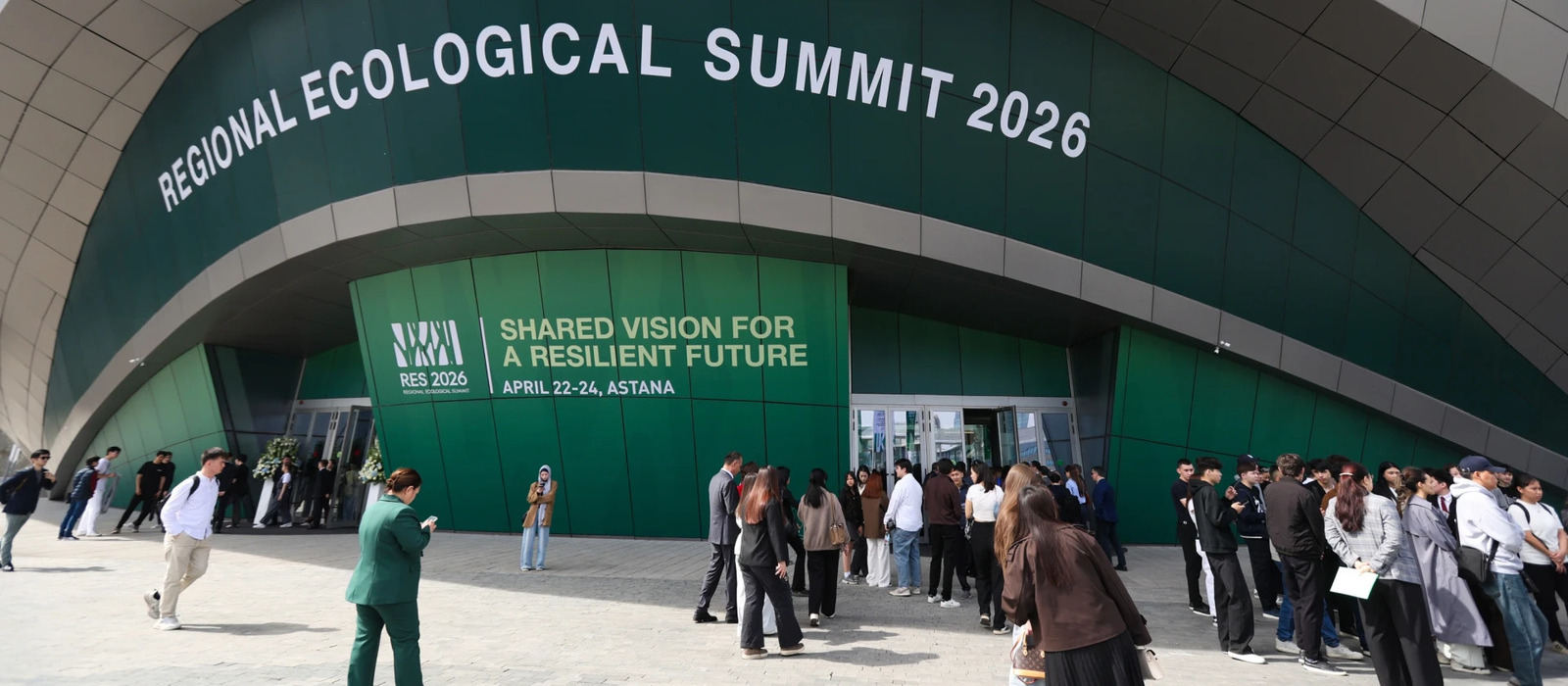
Astana hosted over 1,500 delegates, five heads of state, representatives from eighteen UN agencies, and a trade exhibition that generated $2.3 billion in signed memorandums. By any institutional measure, the Regional Ecological Summit held on 22–24 April 2026 was a success. Kazakhstan, once again, got its moment as a convening power. The region got a Joint Declaration, a five-year action plan, and a new entry on the multilateral calendar.
What it did not get was a conversation about why water governance in the region has failed.
That omission matters, because water — how it is generated, stored, allocated, and priced across five countries with fundamentally different interests — is the defining strategic variable in Central Asia’s environmental future. And water in Central Asia cannot be separated from energy. The two are bound together in a system whose governance architecture is now approaching the real test.
The outlines of the problem are well known. Kyrgyzstan and Tajikistan sit at the headwaters. They hold the glaciers, the rivers, and — through Toktogul and Rogun — the hydropower capacity that could cover their energy needs year-round. Downstream, Kazakhstan and Uzbekistan depend on those same flows to irrigate agriculture that feeds tens of millions of people. The informal arrangement that kept this system functional during the Soviet period — upstream states release water in summer for irrigation, receive energy in winter in exchange — has never been replaced with anything durable. It runs on bilateral deals, seasonal negotiations, and a level of mutual restraint that climate change is now systematically eroding.
The region does have institutions designed to manage this. The Interstate Commission for Water Coordination (ICWC), established in 1992, is mandated to approve annual water withdrawal limits and manage reservoir regimes across all five states. The International Fund for Saving the Aral Sea (IFAS), founded in 1993, provides the broader political umbrella. Both are active. Both have been active for over thirty years. And neither has proven capable of resolving the core upstream-downstream tension when national interests diverge sharply.
On February 20, two months before the summit, the ICWC held a regular session. The agenda was urgent: reservoir levels across the region were critically low, with significant shortfalls projected for the summer growing season. No unified response emerged. The session exposed, rather than bridged, the structural fault line between upstream and downstream states — the same fault line that has defined regional water politics since 1991. Kazakhstan, which in April would host the summit and sign declarations of environmental solidarity, used the occasion to propose replacing the existing framework altogether. Calling for a new body under a Central Asian Framework Convention on Water Management with real enforcement powers, Astana was tacitly acknowledging what three decades of regional cooperation had not resolved: that existing mechanisms can coordinate but cannot compel. Eurasianet, reporting on the session, noted that the ICWC’s “tactical paralysis” was on full display. The upstream-downstream divide was equally visible in who was sitting at the table. Kyrgyzstan — which holds a substantial share of the region’s glacier and river resources — has suspended its full membership and now attends as an observer, signalling that it no longer considers the commission’s allocation framework compatible with its interests as an upstream state.
RES 2026 touched all of this — but carefully, from a distance. Kyrgyzstan’s President Japarov used the summit to argue for a compensation mechanism for upstream water generation. Tajikistan’s Rahmon floated a regional carbon market. Turkmenistan proposed yet another regional council on water use. These are not frivolous proposals. Several have been on the regional agenda for years, however, without the institutional follow-through that would distinguish them from their predecessors.
The summit’s media coverage made the underlying reality visible in a different way. Each country’s press reported through a strictly national lens — Kazakhstan as generous host, Kyrgyzstan as climate victim owed compensation, Uzbekistan as agenda-setter, Tajikistan as water statesman, Turkmenistan as neutral institution-builder. Read together, those five narratives describe five countries using the shared platform to advance incompatible positions while projecting regional solidarity. This is a fairly accurate reflection of where Central Asia actually stands.
The environmental stakes are real and not in dispute. Glaciers are retreating faster than global averages. The Aral Sea basin remains a slow-motion disaster. Dust storms are intensifying. Urban air quality in Tajikistan and Kyrgyzstan is among the worst in the world. Climate change is compressing the seasonal water cycle that the entire regional economy depends on.
Looming over the entire regional water calculus is a factor none of the five governments controls: Afghanistan’s Qosh Tepa Canal, now nearing completion, is projected to divert up to 20 percent of the Amu Darya’s flow — a river on which Uzbekistan and Turkmenistan depend for the bulk of their agricultural water — with no binding agreement or regional mechanism in place.
What is contested is who pays, who gets, and who decides. RES 2026 did not answer those questions. It gave the region a shared vocabulary and a diplomatic framework — both useful — while the operational body responsible for actual water coordination has been struggling. The real test is the next dry season. Reservoir levels across the region do not respond to declarations.
A region that cannot agree on water allocations for the coming summer has nonetheless agreed on a five-year programme for environmental solidarity. The gap between them is where Central Asia’s real environmental politics lives.